
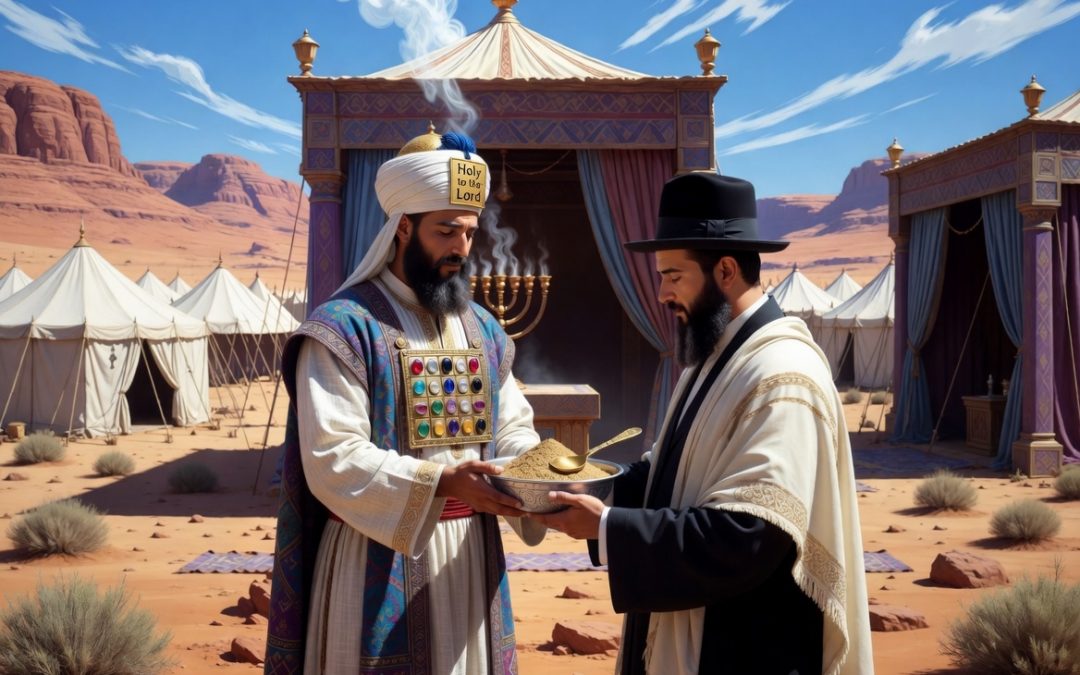
In this week’s reading we learn about the inaugural offerings brought in the Tabernacle in the desert. Each of the tribes of Israel was given a day on which its leader would bring an offering. The tribes were told to come in a specific order, based upon the four flags outlined at the beginning of Sefer Bamidbar (the Book of Numbers), and the tribes that traveled under each. After the offering of Nachshon ben Aminodov of the tribe of Yehudah on the first day, the second was that of Nesanel ben Tzu’ar of the tribe of Yissachar, because Yissachar was the second of the three tribes under the flag of Yehudah.
The offering from Nesanel ben Tzu’ar was precisely that of Nachshon, in every detail. This set a pattern that persists throughout all twelve offerings from all twelve tribes. This also means the Torah takes six verses per tribe to tell us what it could have said in one concise sentence, such as “On the third day, Eliav ben Chelon of the tribe of Zevulun brought the same offering.” We know the Torah wastes no words, so why is it apparently so verbose in this case?
There is one difference, though, in the description of Nesanel’s offering. The Torah twice says, regarding Nesanel, that “he brought.” For every other day the Torah says simply the day, the leader, and his offering. So we now have a second question: why, uniquely by Nesanel, does the Torah add this apparently superfluous detail, and even repeat it?
Rashi explains that the two mentions of “he brought” hint to two reasons to single out Nesanel. First of all, the tribe of Yissocher was knowledgeable in Torah. And second, it was Nesanel who suggested to all of the other leaders to give exactly this same offering. I would suggest that not only are these two reasons connected, but that the underlying rationale helps answer our first question.
The alternative for Nesanel was obvious—he could have brought a different offering, something that expressed his own desire to give. But that would have meant, almost as obviously, that he would have felt obliged to not merely equal, but exceed, the generosity of Nachshon in his different offering. And then what would have happened? Eliav of Zevulun would have felt he needed to outdo both Nachshon and Nesanel on the third day. By the twelfth day, Achira ben Eynan of the tribe of Naftali would have offered all his property and gone into debt, just in order to “keep up.”
“Who is wise? He who perceives the future,” says the Talmud (Tamid 32a). The tribe of Yissocher was knowledgable in Torah, and had acquired wisdom. Thus Nesanel saw what would happen if he brought something different, and squelched his natural inclination to express his individuality in that moment. This is why I believe that the two reasons given by Rashi for the use and repetition of “he brought” to describe Nesanel’s offering are related: Nesanel was given the honor of going second because the tribe of Yissocher was learned in Torah, which gave him the wisdom to bring the same offering as Nachshon’s and show all of the leaders that their offerings should be the same.
The Torah teaches us, then, that this was not merely correct, but precious. To hold back, to refuse to outdo, to consciously squelch the natural inclination to do something different and unique, all place the community, and Hashem, above the individual. And that was why the Torah had to spell out the offerings of each leader—because their very power was that they were the same. It was important to detail the offering of Achira ben Eynan on the twelfth day, no less than that of Nachshon on the first.
The implications for our own lives are obvious, and we should strive not to outdo, but to live to this elevated standard!