Our reading this week begins, “And these are the judgments that you shall place before them” [21:1]. Rashi comments that a statement beginning “these…” rejects or supplants that which came before it, whereas “and these” means to add and connect. In this case, we learn that just as the Ten Commandments were delivered on Mount Sinai, the judgments that we learn in this reading were also said at Sinai.
“Judgments” are civil laws, some form of which are required for any society to function. How must one act towards a fellow citizen who has sold himself into servitude, or had this obligation placed upon him to repay for a theft which he has insufficient funds to cover? What about a maidservant? What is the penalty for murder, or for kidnapping, or for one who curses his parents? These are all areas where nations, both ancient and modern, had rules. So what makes these judgments different?
Rabbi Yehudah Leib Alter, leader of the Gerrer Chassidim at the end of the 19th Century, is called by the name of his work, the Sfas Emes. He explains that placing the judgments at Sinai tells us that the light of the Torah pervades even these laws, as secular as they might seem.
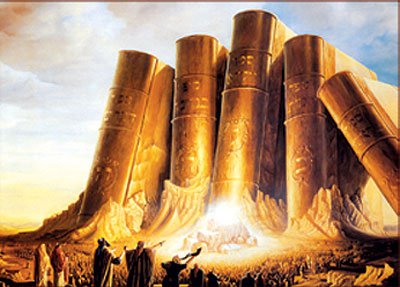
In Rav Alter’s Chassidic teaching, the Torah is one body of light. Before giving the Ten Commandments [really, “Aseres HaDibros,” ten statements, as there are fourteen Commandments therein], the Torah says that Hashem “descended” upon Mt. Sinai [Ex. 19:20], because even to enclose the light of Torah in the Ten Commandments was a “descent.” After that, this same light was spread to “these judgments” which Moshe was instructed to place before the Children of Israel. This means that the judgments between people were also part of that same holiness, drawing the light of Torah into daily life.
He finds a source in the Zohar on Parshas VaEschanan, commenting upon the words “And you shall speak in them” in the Shema prayer [Deut. 6:7]. The Zohar says that management of all our affairs should be “in them,” in the words of the Torah.
It is not enough for Torah to be something we read in the synagogue; it must be part of our every moment, in everything we do. This gives us the opportunity to draw the light of Torah into every aspect of our lives. May we take that opportunity!