In our Torah reading, the Jewish nation is told that they may have a king, but “only that he may not acquire a large number of horses for himself, and not return the nation to Egypt in order to add a horse” [17:16]. This is the first thing that we are told the king may not do. Why is this so significant?
To be the king means to have incredible wealth. Besides whatever treasures the kingdom already has, the king can increase taxes, send out collectors, and build up his coffers. So it is easy to imagine a king becoming overwhelmed with luxuries, and wanting more.
Horses, then, are an example, a model of how the king should be behaving. What does he need so many horses for? He needs enough for his chariot, which is the appropriate way for the king to travel, but he should be happy with that.
Note, too, that the king is supported by the people’s money, rather than earning it himself. So this adds a special obligation to him to be a responsible steward of the public’s money. Yet, given that Egypt was a known source of horses, the Torah says the king might even “return the nation to Egypt” just in order to add a horse!
I am reminded of a time I found a discarded ticket stub on a train. Although it was from Baltimore to Washington, a relatively short trip (I could purchase a first class seat for $73 for travel today), it was for several hundred dollars, truly an astronomical sum of money for such a trip. That made me curious, and I looked up who the customer was. And to no one’s surprise, she turned out to be a high-ranking employee of the National Library, which, per Amtrak, means she received a discount as a government employee.
That’s what can happen when a person is buying on other people’s money. The Torah tells the king to not let things get out of control, to acquire a lot of horses, because were he to travel down that road, he could harm the nation, even take them back to Egypt, just to get another horse. All of us who work for charities or any sort of public service have to consider that we have a responsibility to guard public money even more than we guard our own.
I also saw a new sefer (religious book) from Rabbi Akiva Elazar Admon, Mikra Shlomecha, in which Rabbi Admon applies this same concept to all of us. Buying horses is like a bad habit, he says, or indeed comparable to any wrongdoing. The Chofetz Chaim tells us that the first time a person thinks to do a transgression, it is difficult to convince himself to do it. Once he has trangressed previously, though, it becomes much easier, it doesn’t feel as wrong as it did previously.
In this way, he writes, we can explain why the Torah first tells the king not to acquire a “large number of horses,” but later speaks of taking the nation all the way to Egypt in order to add a single horse. At first, it would be inconceivable that the king would go all the way to Egypt, much less with others, much less return the nation there, just for one horse! But once he was in the habit of adding more and more horses, he could then go to such a ridiculous extent to add one more.
So it is important that one who falls into any sort of bad habit uproot it all the way back to the start, to take himself (or herself) back to as if he or she had never done it before. May we always strive to develop good habits, and use our money responsibly… much less that of others!
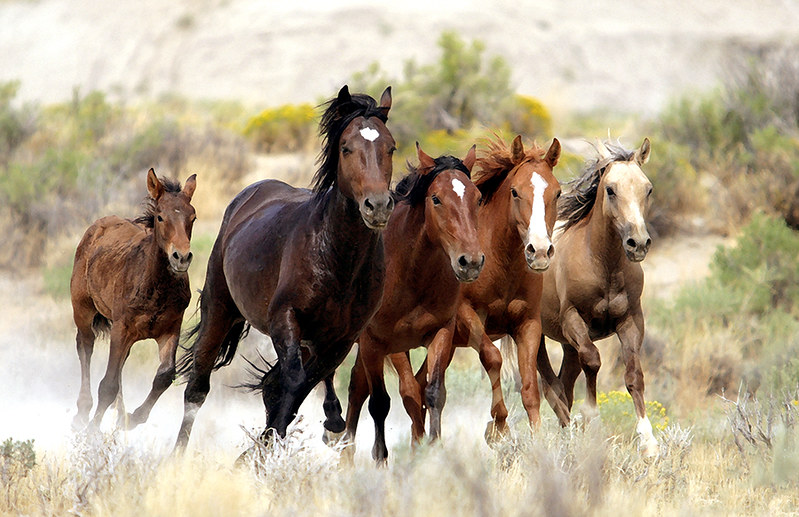
Photo Credit: Wild Horses by Peter Robbins on Flickr with CC BY 2.0 license.